
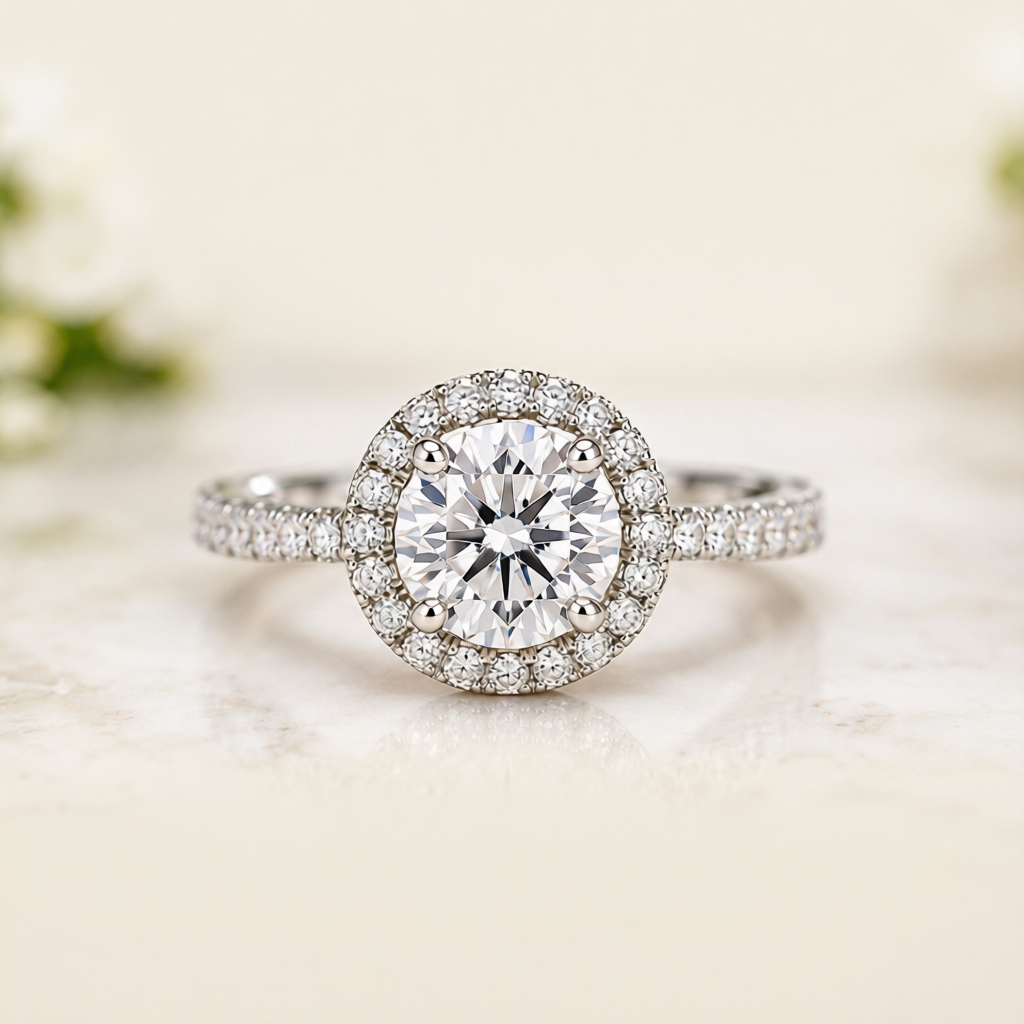
Most people settle on a diamond shape first and think about the setting afterward. With a halo, this approach doesn’t always work. The accent stones do not sit beside the center diamond; they trace it, so the shape you pick becomes the shape of the entire ring.
A round ends up looking like a larger round. A pear gains width at the widest point. An emerald cut reflects a ring of sparkle it does not produce on its own. Some of those outcomes are why people choose the style.
Start With The Outline
In a halo engagement ring, a circle of small diamonds follows the perimeter of the center stone and sits flush against it. The eye takes the two as a single form, which is why the setting adds width without adding carat weight to the middle.
Accent size matters too. Small stones give a fine, continuous line; larger ones create a more defined border that competes a little with the center.
How much width the halo adds depends on the shape underneath. Rounded outlines usually take the halo cleanly. Shapes with corners or points ask more of the setter, and the difference between careful work and rushed work tends to show.
Round, Oval And Cushion
These three are among the easier pairings. A round stone and its halo are both circles, so the two merge into one outline. From a step back, the ring looks like a single, bigger round diamond rather than a stone with a border around it. That is why a halo tends to buy more apparent size here than on other shapes. If apparent size for the carat weight matters most, this pairing usually gets closest.
An oval sits inside an elongated halo that follows its length. The effect flatters the finger, since the setting draws the eye up and down rather than across. Ovals vary in how long they are cut, so compare a few before settling on one. A cushion brings soft corners, softened further by the halo, which suits a vintage feeling without the fragility of an antique stone.
Square And Rectangular Shapes
Princess, emerald, Asscher, and radiant cuts all bring corners, which changes the calculation.
A princess cut gains protection, since the halo covers four points that would otherwise sit exposed. Emerald and Asscher cuts are a different proposition. As step cuts, they produce broad flashes rather than rapid sparkle. Ringing them with brilliant-cut accents creates a contrast some people love, and others find busy. Worth seeing in person before you commit.
A radiant cut splits the difference: the rectangular outline of an emerald with brilliant faceting underneath, so the accents echo the center stone rather than contrast with it.
Pointed Shapes
Pear and marquise cuts come to at least one point, and the halo has to travel around it without blunting it. Handled carefully, the outline stays sharp. Handled loosely, the tip can look crowded.
Two consequences follow. A pointed halo sits wider than the stone at its narrowest part, which affects how a wedding band meets it. More accent stones also sit at the extremities, where they take more contact in daily wear. Many settings add a prong shaped to the tip for that reason.
When A Hidden Halo Makes More Sense
A hidden halo engagement ring places the accent stones beneath the center diamond, facing outward, so they brighten the setting from the side while the outline above stays untouched. For some shapes, that helps.
Step cuts often benefit the most from this. An emerald or Asscher keeps its clean geometry from above, and the sparkle sits underneath where it adds light without competing. Pointed shapes gain too, since a hidden halo engagement ring leaves the tip of a pear or marquise clearly defined. It also suits anyone who likes the brightness of a halo but wants the center stone to stand alone.
A Quick Reference
- Round: among the most seamless pairings, and usually the biggest gain in width
- Oval: elongates the finger, halo following the stone’s length
- Cushion: soft corners on stone and halo, suited to a vintage feeling
- Princess: the halo covers and protects four exposed corners
- Emerald and Asscher: strong contrast between step cut and brilliant accents; judge in person
- Radiant: brilliant faceting means the accents complement rather than contrast
- Pear and marquise: striking when the point is handled well, so examine the tip
Before You Decide
Look at the ring on a hand rather than a display card. A halo engagement ring changes the proportions of the whole piece, and shape differences show more clearly on a finger than in a photograph. Bring the wedding band you plan to wear with it, if you have one. Shape, halo, and band settle into their final proportions once the three sit together.
- John Douglas
- john.david1985jd@gmail.com