
A countertop wash basin sits on top of a bathroom counter instead of hiding under it. It gives your bathroom a bold, modern look. But it also comes with a few problems you should know before you buy one.
This guide covers the real pros and cons of a countertop wash basin, current prices in India, and how to pick the right one for your home.
What is a Countertop Wash Basin?
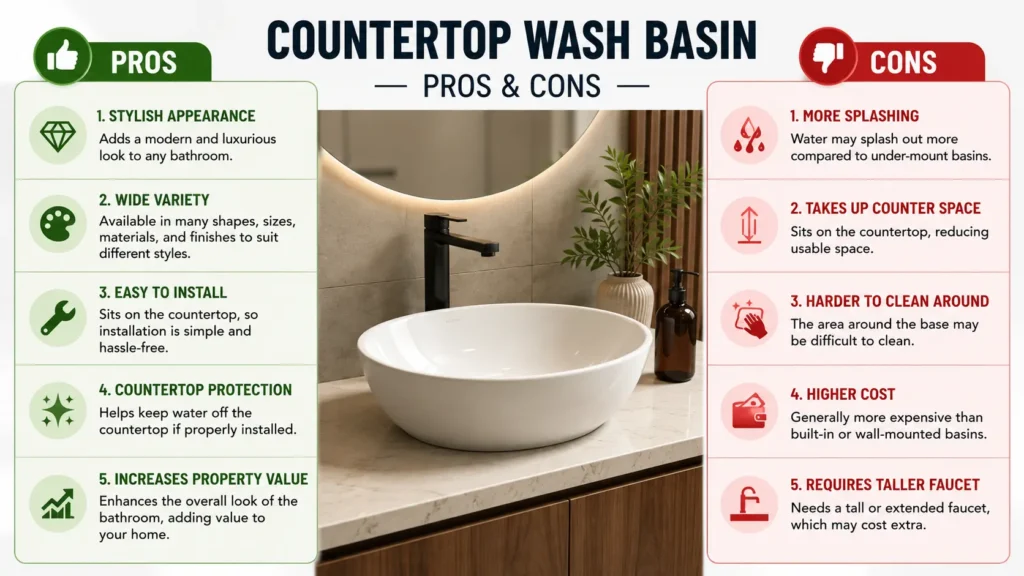
A countertop wash basin rests fully on top of a vanity or counter. People also call it a table top wash basin, vessel basin, or above-counter basin. It is different from a wall-mounted basin, which hangs on the wall, and an under-counter basin, which sits below the counter surface. The bowl shape stays visible, so it becomes a focal point in the room.
Advantages of a Countertop Wash Basin
- Modern and Stylish Look: A countertop basin stands out as a design piece. It comes in round, oval, square, and rectangular shapes, so it fits both classic and modern bathrooms.
- More Material Choices: Most residential basins use ceramic. Vitreous china is a dense, non-porous form of ceramic used for a glossy, scratch-resistant finish, and it is often sold under the name porcelain in Indian catalogs. Beyond ceramic, you can also choose glass, marble, or stainless steel.
- Simple Installation: A countertop basin usually needs only a small cut-out for the waste pipe, which is often easier than fitting an under-counter basin. Some designs still need a fixing ring or a specific faucet setup, so always check the installation sheet first.
- Flexible Vanity Design: Since the basin sits on top, you can design the counter and cabinet around it instead of cutting a large hole for a recessed bowl.
- More Usable Cabinet Volume: A countertop basin usually leaves more open space inside the vanity than a recessed bowl, since less of the basin body sits inside the cabinet. The drainpipe and trap still take up some room, so it is not fully empty space.
- Easy to Replace: If the basin gets damaged, you can often swap it out without changing the whole countertop, as long as the new basin matches the same cutout and waste line.
Disadvantages of a Countertop Wash Basin
- Height Needs Planning: A countertop basin adds height above the counter. If the vanity is not lowered to balance this, the basin rim can sit too high for children, shorter adults, or wheelchair users.
- Faucet Must Match: You need a tall basin mixer or wall-mounted faucet with enough reach. A short faucet on a raised basin can cause water to miss the bowl.
- More Splashing Risk: Splashing depends on basin depth, faucet height, water pressure, and the tap’s aerator. A shallow basin paired with a strong, fast flow can throw water outside the bowl.
- Extra Cleaning Around the Base: Water and soap can collect where the basin meets the counter. The bowl itself is easy to wipe, but this joint needs regular attention to avoid stains.
- Needs a Strong, Level Counter: The counter must support the basin’s full weight and stay perfectly flat, or the seal can fail and cause leaks.
- Visible Water Marks: In areas with hard water, mineral deposits show up more on glass and dark, glossy finishes than on plain ceramic.
- Less Counter Space on Shallow Vanities: Since the bowl sits above the surface, it can take up more usable counter area than a recessed basin, which matters on narrow vanities.
- Stone Basins Need Extra Care: Marble and natural stone basins are porous and need sealing. They can stain or wear from acidic products and are heavier than ceramic, so the counter must be built to hold that weight.
Countertop Wash Basin Price in India
Prices change based on material, brand, and size. The ranges below are an indicative retail estimate based on current listings from Indian sanitaryware sellers and marketplaces, and they can shift over time and by city.
| Material | Approximate Price Range |
| Ceramic/vitreous china (basic glazed) | ₹1,800 – ₹4,500 |
| Ceramic / vitreous china (premium / designer / matte / art) | ₹5,000 – ₹15,000+ |
| Glass (tempered/fused) | ₹3,500 – ₹12,000 |
| Marble / natural stone/terrazzo | ₹6,000 – ₹25,000+ |
| Stainless steel/metal (designer/art basins) | ₹5,000 – ₹20,000+ (highly design-dependent) |
These prices are usually for the basin only. Faucet, waste coupling, bottle trap, and installation charges are normally billed separately, so ask your seller for a full cost breakup before buying. Ceramic and vitreous china remain the most common and budget-friendly choice for Indian homes, while marble and designer glass basins sit at the higher end.
Countertop vs Wall Mounted vs Under Counter Basin
| Factor | Countertop | Wall Mounted | Under Counter |
| Design impact | High | Moderate | Minimal, clean look |
| Cabinet volume | Good | Limited | Moderate |
| Floor space needed | Depends on vanity | Small | Depends on vanity |
| Cleaning effort | Moderate, base needs care | Easy | Easiest, one of its biggest strengths |
| Faucet planning | Important | Important | Usually simpler |
Which Bathroom Suits a Countertop Wash Basin?
A countertop wash basin works well in guest bathrooms, powder rooms, and master bathrooms where design matters most. It also suits homes with a wide vanity counter and enough space around the bowl.
It is often less practical for small bathrooms with narrow counters, busy family bathrooms with heavy daily use, or households with young children, elderly members, or wheelchair users, since the raised height can be harder to reach comfortably.
A well-sized model with a lowered vanity can still work in these cases, so measure carefully rather than ruling it out completely. If low maintenance is your main goal, an under-counter basin is usually the easier choice.
How to Choose the Right Wash Basin
- Measure your vanity width and depth before picking a basin size.
- Check the finished height once the basin sits on the counter, not just the basin’s own height.
- Match the faucet spout height, reach, and flow rate to the basin depth.
- Pick a material based on your local water hardness and cleaning habits.
- Confirm the waste outlet matches your basin and existing plumbing.
- Make sure your countertop is level and strong enough to hold the basin’s weight.
- Ask what the quoted price includes, since faucet and fittings are often extra.
Is a Countertop Wash Basin Worth It?
A countertop wash basin is worth buying if you want a strong design statement and have the space to plan the vanity, faucet, and height correctly. It suits guest bathrooms and premium spaces the best.
If you want the simplest cleaning routine and lowest maintenance, an under-counter or wall-mounted basin may serve you better. The right choice depends on how your bathroom is used every day, not just how the basin looks in the showroom.
Frequently Asked Questions
What is the Standard Height of a Countertop Wash Basin?
There is no single fixed number. Comfortable rim height usually falls between 32 and 36 inches, depending on the users. Because a countertop basin adds height on its own, the vanity below it is often kept lower than a standard vanity to keep the final height comfortable.
How Long Does a Countertop Wash Basin Last?
A good quality ceramic or vitreous china basin can last well over 15 years with normal care, and often much longer if it is not physically damaged. Glass and stone basins may show wear or stains sooner if not cleaned and sealed regularly, especially in hard water areas.
What is IS 2556 and Why Does It Matter?
IS 2556 is a Bureau of Indian Standards series that covers vitreous sanitary appliances, including wash basins. When buying, check whether the specific product complies with the relevant part of this standard and carries a BIS or ISI mark, since this points to tested material and finish quality.
Can You Install a Countertop Basin on Any Countertop Material?
Most countertop basins work with granite, marble, quartz, and solid surface counters, as long as the surface is flat and strong enough to bear the basin’s weight. Laminate counters are more prone to moisture damage, so the area around the cut-out needs careful sealing to prevent water from seeping in.
Do You Need a Plumber to Install a Countertop Wash Basin?
The basin itself is simple to place, but connecting the waste pipe, trap, and water supply correctly needs a plumber in most cases. This avoids leaks and makes sure the drain fitting matches your existing plumbing.
- Begin Faucets
- suraj.k@globalgrades.com