
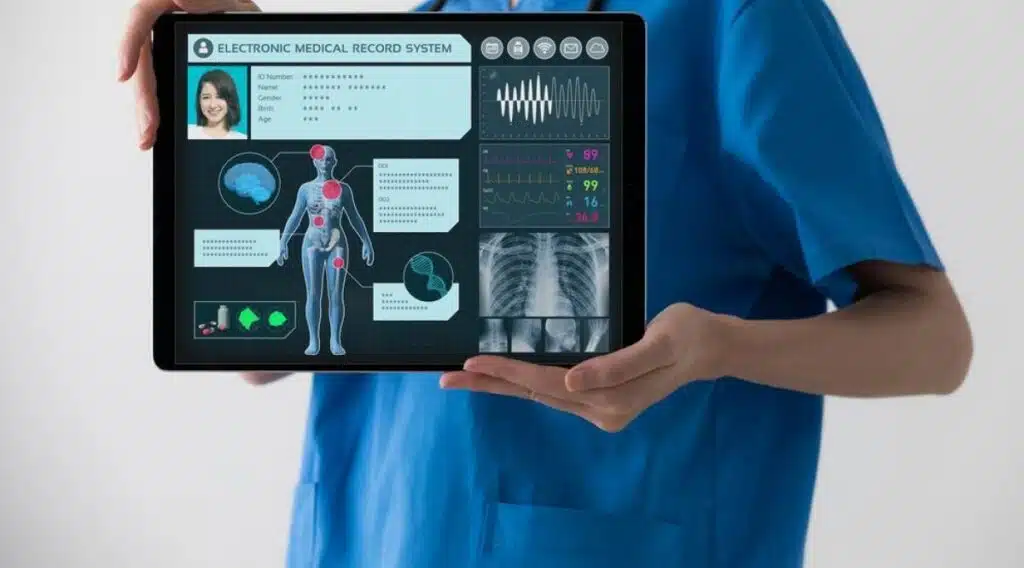
Patient record management systems help healthcare providers streamline workflows, reduce errors, and enhance communication among healthcare providers – leading to better care and outcomes for patients.
PRMSs are databases designed to keep all clinical information, including medication, test reports, and invoices in one convenient place for doctors and nurses to quickly access it without risk of losing important records.
Real-time Access to Patient Information
PRMSs are online systems designed to store electronic medical records and enable patients to interact with healthcare providers more effectively. A PRMS enables easy access to records while helping doctors and nurses avoid tedious manual processes like writing notes on paper and entering data again into another system.
Real-time access to patient information is critical for effective collaboration among healthcare professionals and improved patient care. By eliminating duplicate entries by permitting multiple specialists and facilities access to the same data simultaneously, this platform ensures that decision making uses the most current knowledge resulting in improved outcomes for the patient.
EMR-integrated hospital management software enables doctors to quickly access all pertinent patient data – be it medical history, test results or billing details – without waiting for someone else to manually retrieve it for them. This drastically enhances decision-making and accelerates treatment processes.
As well as improving patient satisfaction, hospital management software enables physicians to concentrate more on treating their patients, which in turn boosts quality of service and increases customer satisfaction. Hospitals can streamline administrative processes through automation such as appointment scheduling, patient portals and insurance processing; additionally it offers staff freeing services like order communications to enable quick-tracked pathology/radiology orders as well as an intuitive Mood Diary App that assists physicians in tracking their mental well-being.
Improved Patient Care
Patients receive improved healthcare services from their doctors by using a hospital patient record management system. The system makes it easy for doctors to access the information they require quickly, saving both time and effort in working with data. It also reduces errors while increasing efficiency by eliminating manual data entry processes and cutting paperwork costs.
Assuring effective admission and discharge by simplifying information collection and collection of patient details. Optimizing OPD/IPD management by improving interaction and interaction record management. Reducing wait times by timely doctor availability; optimizing record management. Offering staff-freeing services like appointment scheduling, telehealth, and communication tools making this an excellent solution for smaller medical practices.
Hospital patient record digitization software offers many advantages for hospitals, so investing in a powerful healthcare management solution makes sense. A powerful PRMS will transform workflow processes while increasing collaboration across departments.
Patienterp is an award-winning EHR that delivers comprehensive functionality, such as telehealth and robust analytics. With customizable templates tailored to each medical specialty and cloud-based accessibility and scalability for greater flexibility and ease of use, this system automates charting while also enabling providers to document freely text documents for increased speed, quality and adaptability.
Reduced Errors
Patienterp Patient Record Management Systems allow hospitals to streamline the entire hospital operation with real-time access and centralizing data to reduce treatment delays, duplicate tests, billing errors and compliance risks. By centralizing information and making real-time access easy for every department of a hospital, PRMS helps decrease treatment delays, duplicate tests, billing errors and compliance risks significantly.
Wrong-patient errors arise when people or technology misidentify patients during registration, documentation and delivery of items such as blood, medication, specimens and devices to them. Preventing errors requires effective identification, efficient EHR controls, barcode scanning verification and duplicate detection systems, rigorous data standards and qualified personnel. Utilize standard verification scripts, augment with quarterly microlearning activities and use real-time simulation drills to demonstrate competency. Verify all identifiers by requiring all users to enter a full legal name, DOB and Medical Record Number; use pause-and-point at the on-screen patient banner for orders, notes and imaging; and limit location-based identifiers to beds and rooms.
Utilize regular Quality Assurance audits that sample notes, orders and results for cross-patient references and outdated copy-forwards; monitor error rates by monitoring leading indicators (near-miss reports) and lagging ones (confirmed wrong-chart events). Apply structured analyses (process mapping, Five Whys and fishbone) to identify human and workflow contributors to problems; translate findings into countermeasures including policy adjustments, interface tweaks or staffing changes as countermeasures – sharing findings in huddles to encourage open reporting and collaborative fixes.
Improved Patient Satisfaction
PRMS allows doctors to easily record patient histories, prescriptions, test reports and appointment dates in an efficient and paper-free way, saving both time and resources to locate information faster – helping hospitals boost operational efficiency while simultaneously improving medical care services.
Hospital Patient Healthcare Record Management System offer another key benefit for patient satisfaction: They allow them to check their records at any time they choose and enable doctors and nurses to communicate efficiently between themselves – thus eliminating miscommunication or delays in treatment.
The Hospital Patient Healthcare Record Management System brings clinical, practice management, revenue cycle management, and revenue cycle compliance workflows under one centralized platform – eliminating the need for multiple separate software systems and streamlining workflows with features designed to enhance patient experience while simultaneously mitigating compliance risk and increasing practice growth.
Patienterp EMR features AI-driven learning to increase medical accuracy by recalling past cases that feature consistently high-quality documentation, eliminating unnecessary clicks and drop-down menus and improving usability and accessibility for its physician users. With its template-free design reducing charting fatigue by eliminating redundant clicks and drop-down menus and its focus on physician user satisfaction improving usability and accessibility – Patienterp is an ideal choice for independent practices looking for customization and flexibility, offering features like digital intake forms and communication tools which boost practice revenue and patient engagement, as well as robust interoperability and extensive functionality making it ideal for large healthcare organizations.
- Dronyusk
- Dronyusk@outlook.com